The Perception Delusion
Why leaders think they're having difficult conversations (but employees disagree)


45% of leaders say they proactively engage in difficult conversations. Only 23% of employees agree. They’re not perceiving the same thing differently—they’re experiencing fundamentally different realities.
There’s a stunning gap in how leaders and employees experience workplace communication, and it’s costing organizations more than they realize.
According to recent research (see footnote1), 45% of leaders report that they proactively engage in difficult conversations with their teams. Translation: I experience myself having conversations that are challenging and difficult. That sounds promising until you ask employees. Only 23% agree that their leaders actually have these conversations. Translation? They may have unpleasant conversations, but not difficult ones if we define “difficult” in part as challenging but necessary (for progress, for evolution, for results, for breakthroughs).
This isn’t a minor perception difference. It’s a 22-percentage-point chasm between what leaders think they’re doing and what employees actually experience.
Most explanations for this gap focus on perception: Leaders think they’re being clear, but employees aren’t hearing it; or communication style: Leaders need better delivery skills; or psychological safety: Employees don’t feel safe acknowledging the conversation happened; or, even more tragically, it was a costume drama of a conversation: Proverbially, it was tap dancing, the real conversation didn’t happen, some rhetorical chess pieces got moved around.
How do you know a conversation really happened? It cuts to the core of what matters most in that situation, and it simply cannot leave the matter unchanged.
But what if we’re asking the wrong question?
What if leaders and employees aren’t perceiving the same phenomenon differently—but experiencing fundamentally different phenomena altogether?
The question isn’t whether difficult conversations will happen in your organization. They already are—somewhere between 45% and 23% of the time, depending on whose reality you believe. The question is: Will you navigate them or just survive them?
What Actually Makes a Conversation Difficult?
We throw around the phrase difficult conversation as if we all know what it means. But ask ten people to define it, and you’ll get ten different answers: When you have to deliver bad news, when emotions run high, when there’s potential for conflict, when the topic is sensitive.
These definitions all describe symptoms—discomfort, tension, emotional charge—but they miss the structural reality of what actually makes a conversation difficult.
After 35 years working across six continents with organizations in crisis, post-conflict reconciliation, and organizational transformation, I’ve observed that truly difficult conversations share six specific structural conditions:
1. Perceived futility – The belief that this won’t change anything
2. Potential volatility – Real risk of emotional explosion or escalation
3. Ability to flee – One or both parties can disengage, dismiss, or disappear
4. No real agreement to engage – Only one party actually consented to the difficulty and duress with an aim to making shared progress
5. Pointless pain – The prospect of suffering without meaningful outcome
6. Scope for large-scale rationalization – Both parties can construct elaborate justifications for why they were right
When these six conditions are present, conversation becomes genuinely difficult. Not just uncomfortable—structurally precarious, with high risk of catastrophic failure.
Here’s what most leaders don’t realize: their position and power systematically eliminate these conditions when they initiate conversations, insulating them to some extent, while traumatizing those on the receiving end.
The Leader’s Reality: Managed Discomfort, Not Actual Difficulty
When a leader decides to have what they call a difficult conversation, here’s what they actually experience:
✗ Not futile – They have authority to act on what’s discussed. Decisions can be made, resources allocated, policies changed.
✗ Not volatile – They control the setting, tone, agenda. HR can be present if needed. Security exists if things go wrong.
✗ Can’t flee – Organizational hierarchy makes the conversation mandatory. The employee can’t simply walk out or refuse to engage.
✗ Agreement secured – When a leader says, “We need to talk,” it’s not optional. Consent is built into the power structure.
✗ Not pointless – They have decision-making authority. The conversation will lead to action (even if grudging) because they can ensure it does.
✗ Limited rationalization – They can enforce the truth of what happened. Their version becomes the official record.
What the leader experiences is managed discomfort—a conversation that feels uncomfortable but occurs within controlled conditions that minimize genuine risk.
They felt nervous before the conversation. They chose their words carefully. They noticed the tension in the room. They lost sleep the night before.
So, when they check the box, “I proactively engage in difficult conversations,” they’re being honest about their subjective experience.
The problem? That’s not what their employee experienced.
The Employee’s Reality: All Six Conditions, Externally and Internally
When an employee needs to raise a concern with their leader, they face all six conditions as external realities:
✓ Futility – “My boss won’t actually change anything. This is just going through motions.”
✓ Volatility – “This could blow up my career. One wrong word, and I’m done.”
✓ Can flee – “My boss can dismiss me, the concern, or my credibility with no consequence.”
✓ No agreement – “My boss isn’t actually open to hearing this, they’re just performing openness.”
✓ Pointless pain – “I’ll suffer for bringing this up, and nothing will change.”
✓ Massive rationalization – “Whatever I say, my boss will reframe it as me being the problem.”
This is genuine difficulty, structurally precarious conversation with high risk of catastrophic failure and no power to control the conditions.
But here’s what makes the gap even more insidious: even when leaders create what they think are “safe” conditions for difficult conversations, employees experience all six conditions internally.
The leader sees:
Employee nodding
“That makes sense”
“I understand”
“I’ll work on that”
What’s actually happening inside the employee:
Internal volatility (“I’m about to lose it but can’t show it”)
Psychological flight (“I’ve checked out, just managing my face”)
Perceived futility (“Nothing I say will change this”)
Rationalization storm (“Here’s why they’re wrong, but I can’t say it”)
Pointless pain (“Suffering this for no gain”)
Then comes what I call the Corporate Default Jig: “Say ‘yes’, do ‘no.’”
The leader leaves thinking: “That went well. They understood.”
The employee’s reality: Already mentally quit, emotionally exasperated; planning workarounds; telling themselves a story about what just happened.
We have a crisis. What isn’t said is deafening, and this way we uncover why that is, and to make difficult conversations into the breakthroughs they should be.
The Wrecking Ball Problem
Even well-intentioned leaders typically deliver difficult messages in ways that trigger all six conditions inside employees.
Corporate transformations are among the most insidious wastes of time, energy and credibility. Across the globe, across markets, across industries, I have seen a corporate CEO, carefully prepped by internal “handlers” and “brokers” to deliver what they think will be a rousing evangel. “We are going to create a Path to Growth. We will put all our money behind our biggest brands. We are going to streamline and transform supply chain. We are going to create an enterprise culture. We will deliver real success for our consumers and customers, etc.…”
Swooning with corporate pride, with soundbite after soundbite chiseled over sleepless nights. The recipients? Dumbfounded. Not sure why? Why now? Thinking internally: Been there, done that; this too shall pass. Concerned that everyone implicated will rationalize not changing, and death by PowerPoint will be the chief achievement.
I recall a famous simplicity initiative where the presentation on simplifying took over 50 slides! I gently inquired, and the audience, insulated by my presence, roared with laughter, leaving the leader beet faced and shocked at the perception gap.
He gave it to his team to simplify. They returned with 35 slides (essentially, they just changed the font size!). For the employee the haplessness, the hopelessness and the sheer irrelevance (no one ever asks them or recruits their help to make such change efforts real) intensify.
The leaders who control everything, go through their check-list, congratulating themselves, but forgetting the NLP core insight, “communication occurs at the end of the receiver, not the sender.”
The pattern I’ve observed across organizations on six continents is remarkably consistent:
Leaders deliver judgments and diagnoses:
“Your performance has been subpar.”
“The team finds you difficult to work with.”
“You need to improve your communication.”
These frame the conversation as verdict, not partnership. The employee isn’t being enrolled in solving a problem—they’re receiving judgment about who they are or what they’ve done wrong.
Even when leaders try to soften it (“I want to help you succeed here...”), the employee experiences:
Futility (decision’s already made)
Volatility (threat to identity/security)
No real agreement (didn’t consent to being diagnosed)
Pointless pain (just enduring verdict)
Rationalization (”Here’s the story I’ll tell myself about this”)
Result: Corporate Default Jig: surface compliance, internal resistance.
The leader thinks they had a difficult conversation. The employee thinks they survived, or are at least “trying to dodge” a wrecking ball.
This is the perception gap.
The Port City Insight
Historian Will Durant observed that throughout history innovation came from port cities, not from capitals, not from wealthy centers, from ports—where the world collided unavoidably.
The spice merchant, the sailor, the banker, the philosopher, the prostitute—they shared cramped streets, taverns, dangers. Collision was unavoidable.
Read more about Will Durant’s port city insight in my Medium article “The Homogenization of Collision” https://3s-consulting.medium.com/the-homogenization-of-collision-e04826ef133d
What made port cities innovative wasn’t just diversity. It was necessary interaction. You couldn’t avoid the encouner with the unlike-minded, the differently valued, the friction you didn’t choose.
Modern cities—and modern organizations—have made collision optional. The comfortable increasingly opt out. The others realize friction here is imposed for control, it is punishment, not a pathway.
Echo chambers abound, and salons have disappeared. The original meaning of the word “symposia” was a drinking party where people gathered to share ideas and drink. “Communion” referred not just to religious transcendence, but the deepest connection, where community, intimacy and grace abounded emerging from intense interaction. Society was about creative contention, about jostling and being jostled, about stimulus, and thereby becoming more than the sum of our parts.
Now we have affirmation massage parlors, and curated experiences where we ensure our ego becomes the logarithm. We have cliques and cults rather than communities, and cities are far more ideological ghettos (though segregated on the basis of bias and default paradigms) rather than thriving entrepots where discovery abounded while still leaving room for cultural oases for deeper immersion and enrichment.
The same thing has happened with difficult conversations.
We’ve created the appearance of collision without its actual friction:
“Open door policies” that require appointments
“Town halls” with pre-screened questions
“360 reviews” designed for comfort
“Psychological safety training” that teaches avoidance
“Candor” that’s carefully boundaried
We get performed difficulty instead of genuine navigation.
Jack Welch’s one-sheet principle was: “If you can’t explain your project in one sheet, you don’t understand it yourself yet. Don’t use me to figure it out.”
The Navigate System: Making Collision Navigable, Not Optional
Durant’s port cities worked because collision was unavoidable and structured. You couldn’t sprawl infinitely. You needed the baker, the merchant, the neighbor. Narrow streets and shared threats meant you dealt with everyone.
Organizations need the same principle: Make difficult conversations unavoidable and give both parties tools to navigate them.
This requires a bidirectional system with preparation by both parties.
Upward Navigation: When Employees Need to Initiate
The structural problem: Employees face all six conditions when trying to raise concerns upward, with no power to eliminate them.
The solution: The Navigate Request System
How it works:
1. Employee prepares a Navigate Request One-Sheet (inspired by Jack Welch’s GE principle in having projects presented to top leadership for quick, vigorous review and to see if further consideration and presentation was justified: “If you can’t explain it in one sheet, you don’t understand it yourself yet. Don’t use me to figure it out.”)
The one-sheet must include:
Qualifying criterion (check one):
Key information leader needs
Important idea to vet
Emotional concern affecting performance
Innovative prototype with potential
The issue (2-3 sentences, observation not interpretation, no diagnoses, actual observations, verifiable in others’ experiences)
Why it matters (impact on team/goals/performance)
What I feel (emotional reality: “I feel anxious/frustrated/excited because...”)
What I need (specific, actionable request)
Shared aspirations (how this serves our larger goals)
Options I see or questions I want us to explore together (not just problems, but possibilities)
2. Leader has 48 hours to:
Grant + prepare their own response one-sheet, OR
Request clarification, OR
Decline with explanation
3. If granted, leader prepares Navigate Response One-Sheet:
What I heard and my experience (observation, not interpretation)
What I feel about this situation
What I need to clarify or have confirmed
What I can/can’t commit to and why
Shared aspirations I see
Questions for our Navigate session
(This, however, is a discipline and for the record, and to ensure due attention was paid, and a core conversation prepared for. During the dialogue this shouldn’t be a straitjacket. The key is to agree the “observations,” share “feelings,” understand the “needs” (organizational and individual), and then find a way forward that advances the aims of the organizations and then the needs of the individuals involved).
4. Both enter conversation with documents
Not one person delivering, both navigating together
Documents keep both accountable
Can refer back during conversation if it gets difficult
This doesn’t eliminate the six conditions, but it makes them survivable:
Less futility (leader prepared response, shows seriousness)
Contained volatility (both framed in feelings/needs, not judgments)
Harder to flee (both prepared documents, mutual obligation)
Real agreement (leader granted the Navigate Request)
Less pointless pain (clear purpose and path forward)
Less rationalization (observable framing in documents)
Downward Navigation: When Leaders Need to Deliver Difficulty
Here’s the symmetry that completes the system: Leaders prepare one-sheets too.
How it works:
1. Leader prepares Navigate One-Sheet BEFORE scheduling conversation:
The observation (not interpretation)
What I feel about this situation
What I need
What I imagine you might be feeling
Shared aspirations (why this matters for both of us)
Options I see for moving forward
2. Leader sends one-sheet to employee with meeting invite:
“I need to discuss [topic]. I’ve prepared this Navigate sheet so you can see how I’m framing this. Let’s meet [time] to discuss. You’re welcome to prepare your own response if that helps.”
3. Employee has option to prepare response one-sheet
4. Both enter conversation with documents
Why this prevents the wrecking ball:
When the leader must prepare in writing first:
Can’t hide behind power – Must articulate clearly before entering room.
Forced to separate observation from interpretation – The one-sheet structure requires it.
Shows respect – “I took time to prepare how to navigate this with you.”
Mobilizes best in recipient – Employee sees leader is trying to navigate, not inflict.
When difficulty lands at the level of feelings and needs instead of judgments and diagnoses, when it’s framed as partnership instead of verdict, the employee can actually engage instead of just surviving.
Leaders are also welcome, where something is really non-negotiable to have “how” rather than “if” conversations, e.g.,
“We are mandated to create some cost savings. Here’s why. And here’s what would constitute savings. I feel troubled about the impact this could have. I have a need to do this as fairly, decisively and humanely as possible, and I have a need to get the best counsel from team members like you. It’s crucial, though, that it be a “how” conversation, as the “if” is off the table, it does need to happen., I am looking forward to our finding the most effective and fair way forward that we can best be proud of given the realities.”
There is not ‘threat’ here, no ‘attack’, but also no equivocation or fuzziness.
The six conditions don’t disappear, but the employee experiences:
Less futility (my needs are being explored, not ignored).
Contained volatility (my feelings are being acknowledged, not suppressed).
Less flee (I’m being enrolled in solving, not just receiving verdict).
Less pointless pain (genuine partnership in finding solution).
Less rationalization (leader’s framing is observable, I can engage with it).
Result: Real engagement, “Okay, I can work with this.”
People almost never change without first feeling understood. —Douglas Stone
Implementation: The Welch Discipline Applied Bidirectionally
Jack Welch’s one-sheet principle was: “If you can’t explain your project in one sheet, you don’t understand it yourself yet. Don’t use me to figure it out.”
Applied to difficult conversations:
For employees: “If you can’t frame your Navigate Request in one sheet using feelings/needs/shared aspirations, you’re not ready to have the conversation yet. Do the internal work first.”
For leaders: “If you can’t frame your difficult message in one sheet separating observation from interpretation, you don’t understand it clearly enough yet. Don’t use your employee to figure it out while you’re delivering it.”
The discipline is bidirectional.
Both parties must:
Prepare in writing
Use the same framework (feelings/needs/shared aspirations, not judgments/diagnoses)
Separate observation from interpretation
Enter with documents which embodies the care being lavished and preparation undertaken
Navigate together
This creates mutual accountability to quality of framing.
What This Changes
The 45%/23% gap exists because we’ve been asking leaders to “get better at difficult conversations” while leaving the structural conditions unchanged.
Leaders can’t eliminate the difficulty inherent in power differentials, uncertain outcomes, and genuine risks. What they can do is:
Recognize that what they experience as “difficult” often isn’t – because their power eliminates the external conditions.
Prepare in ways that prevent internal difficulty for employees – through Navigate one-sheets that frame issues at the level of feelings/needs/partnership.
Create formal pathways for employees to initiate upward – Navigate Request system that keeps needed collision unavoidable but navigable.
Use the same framework in both directions – bidirectional preparation with mutual accountability.
This isn’t about making conversations comfortable. It’s about making genuine collision navigable instead of optional.
Durant’s port cities didn’t thrive because they eliminated friction—they thrived because the friction was unavoidable and structured. The merchant couldn’t avoid the philosopher. The sailor couldn’t avoid the banker. Collision happened, and from it came innovation. The paradigm was embraced and lived into.
Organizations need the same principle. Not psychological safety that eliminates difficulty, but navigational systems that make difficulty productive.
We want to take action out of the desire to contribute to life rather than out of fear, guilt, shame or obligation. —Marshall Rosenberg
Beyond the Workplace
This Navigate system isn’t limited to organizational hierarchies. The same six structural conditions exist in personal relationships—marriages, families, friendships—where impossible conversations hold critical relationships hostage.
The difference: in personal relationships, both parties must voluntarily consent to the invitation. Neither has positional authority to compel the conversation, which makes the mutual preparation even more powerful when both choose it.
The one-sheet becomes here not a mandated discipline nor a draconian imposition, but a gesture of care, of the deepest emotional affection and respect: “I value this relationship enough to do the hard work of framing this clearly, and I’m inviting you to do the same. I care too much to have us get this wrong. To get it ‘right’ is to arrive at it together.”
A “Difficult Conversation” is one, which if conducted in a way that enrolls and connects, through the learning that takes place, makes the other person smarter (IQ or EQ, or both). And if they’re on your team, that makes you smarter (IQ, or EQ, or both). And thereby, it makes your whole team and organization “smarter”. Quite a dividend, and quite an incentive to learn to have such conversations early and often! —Omar Khan
The Question
The question isn’t whether difficult conversations will happen in your organization. They already are—somewhere between 45% and 23% of the time, depending on whose reality you believe.
The question is: Will you navigate them or just survive them?
Navigation requires preparation from both parties. It requires recognizing that power doesn’t eliminate difficulty—it just changes who experiences which conditions. It requires one-sheet discipline that forces clarity, accountability, and mutual respect. And it requires accepting that some conversations will always be difficult. The goal isn’t to make them comfortable. It’s to plumb them for their potential as real guiding lights.
Because the alternative—the Corporate Default Jig of say yes, do no, the wrecking balls disguised as feedback, the impossible conversations that fester for years—isn’t working, not for the 23% of employees who know their leaders aren’t really having the conversations they claim to be having. And ultimately, not for the 45% of leaders who think they are and wonder at the apathy and disdain they get too often in return.
And finally, shelve the percentages, if you like. Do we have a crisis of theory in action NOT matching theory in use in terms of necessary conversations occur in a timely, courageous, creative and supportive fashion? Of course we do, compared sadly with an area of recurring competence in too many organizations like kowtowing to authority?
We have a crisis. What isn’t said is deafening, and this way we uncover why that is, and learn how to make difficult conversations into the breakthroughs they should be.
Omar Khan is Founder & Principal of 3S Catalyst Consulting and author of Loving Assertiveness: A Framework for Authentic Communication. He has spent 35+ years working with organizations and communities across six continents, including post-conflict reconciliation work and organizational transformation. Recognized by Consulting Magazine as one of the top 25 consultants worldwide, he was mentored by Dr. M. Scott Peck and is an Oxford University alumnus.
Connect: www.3-s-consulting.com
https://www.linkedin.com/company/3s-catalyst-consulting/
->The article about my recent book, Loving Assertiveness:
“The Tea That Changed Everything”
Loving Assertiveness is how we bring ourselves back, to ourselves and each other, to connection, to community, to true collaboration, and forward to the triple win: I win/you win/the world wins.
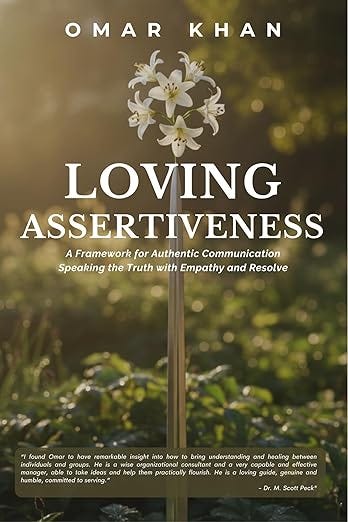
Loving Assertiveness: A Framework for Authentic Communication: Speaking the Truth with Empathy and Resolve, paperback and ebook link:
https://tinyurl.com/lovingassertiveness-pb
https://tinyurl.com/lovingassertiveness-eb
→This piece expands on themes I explored in my recent Founders Story podcast interview about Loving Assertiveness. Listen to the full conversation Youtube:
#Communication #Organizational Development #Workplace Culture #Employee Engagement #Leadership
Footnote:
¹ Axios HQ, “8 Internal Communication Trends Shaping Workplaces in 2025” - Survey of 457 executives. https://www.axioshq.com/insights/internal-communication-trends