When “Love” Isn’t Enough
What your relationships need in 2026


Our relationships are the conversations they are made up of, not the conversations we wish we could have, not the ones we rehearse silently--the actual words we exchange, or more often, the ones we carefully avoid.
Loving relationships held hostage by the fear of painful and challenging conversations. That’s where most of us live, close enough to care, distant enough to stay safe. We convince ourselves we’re protecting the relationship by not saying what needs to be said.
But avoidance compounds. Year after year the gap between what we feel and what we share grows wider. The relationship plateaus, diminishes, becomes less than what it could be.
R.D. Laing wrote:
What we think is less than what we know. What we know is less than what we love. What we love is so much less than what there is. And to that precise extent, we are so much less than what we are.
Here’s the relational truth hidden in that quote:
What we say is less than what we think. What we think is less than what we feel. What we feel is so much less than what love requires us to share. And to that precise extent, our relationships are, in practice, so much less than what they are in potential and possibility.
We jockey for position. We craft careful phrases. We manage reactions. We call this “being considerate” or “keeping the peace.” But really, we’re just trapped in the shallow end, exhausted from treading water.
The Holiday Period
You’ll sit across from people you love this season, parents, partners, children, siblings, friends who’ve become family.
And somewhere in the evening, there will be a moment, a pause where something real could be said, where years of careful avoidance could finally break open into honest conversation. It needn’t be dire. It could be an opening where fresh depths could be plumbed, or the tumblers of deeper joy turned.
Most of us will let that moment pass. We’ll smile, change the subject, pour another drink, tell ourselves there will be a better time.
There won’t be, not because the opportunity won’t come again—it will, year after year—but because we still may not have the tools to navigate the conversation without causing the harm, we fear; or we don’t know how to “ask” for the “glory” of embracing each other, in whatever way beckons, wholeheartedly, rather than with the “brakes” still on.
Every time I mess up, is a chance to practice. Marshall Rosenberg
Why “Love” Isn’t Enough
But here’s the deeper truth: the problem isn’t just that we avoid difficult or demanding or stretching conversations, it’s that we mistake strategic maneuvering for love itself.
Love trapped in intentionality isn’t love yet. It’s potential. It becomes love only when it is shared expansively—with the fullness of what’s alive in us—and when we welcome all that’s alive in others.
We need a Rosetta stone between what lives inside us and what we’re able to share, and the truest path to that translation runs through needs, not strategies.
Our strategies are the hostage takers. They keep us thrashing around in an emotional moat of our own making: “If I say this, they’ll think that. If they respond this way, I’ll counter with that. If I’m vulnerable, I’ll get hurt. If I’m honest, I’ll cause pain.”
We jockey for position. We craft careful phrases. We manage reactions. We call this “being considerate” or “keeping the peace.” But really, we’re just trapped in the shallow end, exhausted from treading water.
Needs bring purifying springs. They open the locks. When we dive beneath our strategies to discover what’s actually animating us—what we genuinely need, what truly matters—and when we create safety for others to do the same, relating becomes art, a loving art.
When people are safe to be themselves, when our needs can be tapped into and shared, there is never “enough” of that life-giving spring, that Pierian Spring, it is almost inexhaustible.
Alexander Pope wrote:
A little learning is a dangerous thing; Drink deep, or taste not the Pierian Spring: There shallow draughts intoxicate the brain, And drinking largely sobers us again.
Here’s the relational truth hidden in that warning:
A little loving is a dangerous thing—a vanity play and an ego diversion.
What Actually Changes Things
After just two sessions in a recent workshop, a participant wrote:
“I can’t imagine how Loving Assertiveness could work that quickly, how deeply we could learn to “touch” each other. We have had a good relationship but we have been avoiding some important conversations and decisions because they are painful. A part of our openness and what we hoped for was locked away. Well, it’s flowing now! I can’t believe it. Thank you for your guiding light.”
Two sessions. The miracle, of course, was of her own making. I hope we lovingly shared some tools and faith in her ability to put them to beautiful use. Years of avoidance, finally addressed.
And this is not because she suddenly became braver. Instead, it’s because she learned the difference between strategies and needs, how to dive beneath the surface to what’s actually alive, how to say what’s true without making it an attack, how to listen without defending, how to invite a larger exchange without “demanding” or “threatening” in any way to foreclose the other person’s autonomy, how to hold both care and clarity without compromising either.
She learned to drink deeply instead of offering shallow draughts.
This is what Loving Assertiveness teaches: The painful or even challenging conversations don’t have to be destructive. They can be the very thing that deepens connection rather than fractures it. They can excite and inspire rather than feel presumptuous, but only when we stop jockeying strategically and start touching and connecting from what we genuinely need—and welcoming what the other genuinely needs, with real emotional hospitality.
The glorious songwriter Ruth Bebermeyer encapsulates it so well:
The hawk within your heart’s not bound to earth by fence of mine, unless you aren’t aware that you can fly.
When I come gently to you, I want you to know, I come not to trespass your space, I want to touch and grow. When your space and my space meet, each is not less but more. We make our space that wasn’t space before.
When I come gently to you I want you to see, it’s not to get myself from you, it’s just to give you me. I know that you can’t give me me, no matter what you do. And all I ever want from you is you.
The Year Ahead
Most New Year’s resolutions are about changing yourself, losing weight, making more money, reading more books.
What if 2026 was about changing the conversations you’re avoiding—and more importantly, changing the level at which you’re relating?
Maybe adding more of these to your life, equally unlocking what’s already there. The connection that exists between you and the people you love, held hostage by strategic fear and shallow loving. Being open to welcoming and to evoking “revolutionary” and “evolutionary” conversations and relationships that will excite, enrich and beautifully transform everything that matters to you.
The gap between what you feel and what you share doesn’t close on its own. Time doesn’t fix it. Good intentions don’t bridge it. Staying in the shallow end just exhausts everyone.
What bridges it: learning to dive into needs; to share what’s fully alive in you; to welcome what’s alive in others; to drink deeply from the Pierian Spring rather than offering careful, measured sips.
What we say can equal what we think. What we think can better approach what we feel. What we feel can be shared in ways love not only permits but invites, welcomes, perhaps even seeks and requires. And to that precise extent, our relationships can become everything they’re meant to be—not through strategy, through needs, through depth, through the courage to stop sloshing around in the emotional moat and finally, finally to drink deeply together and learning to dance together in those life-giving waters.
And still, after all this time, the sun never says to the earth, “You owe me.”
Look what happens with a love like that, it lights the Whole Sky.
—Hafiz
Let’s share that gift during Christmas. And we’ll discover then in what way Love can be—as this season of immortal mercy invites us to experience—more than enough and everything we ever wanted it to be.
About the author:
Omar Khan is Founder & Principal of 3S Catalyst Consulting and author of Loving Assertiveness: A Framework for Authentic Communication. He has spent 35+ years working with organizations and communities across six continents, including post-conflict reconciliation work and organizational transformation. Recognized by Consulting Magazine as one of the top 25 consultants worldwide, he was mentored by Dr. M. Scott Peck and is an Oxford University alumnus. Find him at www.lovingassertiveness.com
Ready to dive deeper?
3S Catalyst Consulting, https://3-s-consulting.com/
Loving Assertiveness workshops teach the frameworks that make this depth and breadth possible—how to move from strategies to needs, from shallow to deep, from jockeying to genuine connection.
The dates of the upcoming Loving Assertiveness workshop are: March 17th, 19th, 24th & 26th, 2026, 10:30 a.m.-12:30 U.S. Eastern Standard Time (link below).
https://drive.google.com/file/d/1ce_8PgRB4zcmOOJfMA935e_Rtc9cmqg9/view?usp=sharing
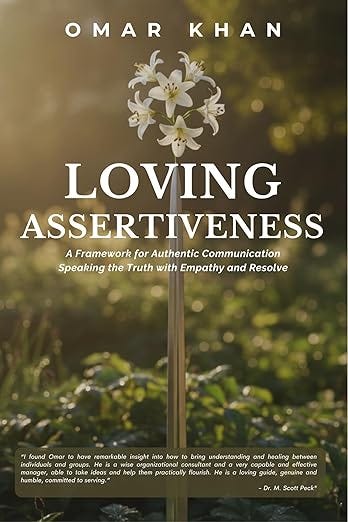
Or start with the book: Loving Assertiveness: A Framework for Authentic Communication is how we bring ourselves back, to ourselves and each other, to connection, to community, to true collaboration, and forward to the triple win: I win/you win/the world wins.
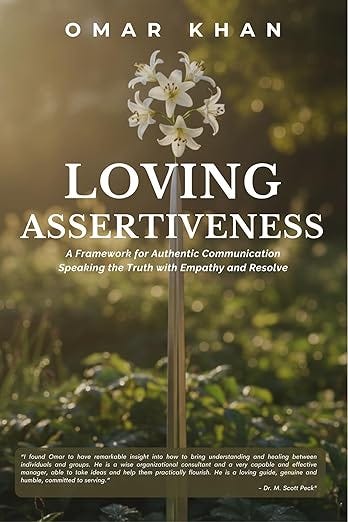
Loving Assertiveness: A Framework for Authentic Communication: Speaking the Truth with Empathy and Resolve, paperback and ebook link:
This piece expands on themes I explored in my recent Founders Story podcast interview about Loving Assertiveness. Listen to the full conversation Youtube:
->The articles about Omar Khan’s book, Loving Assertiveness:
https://omarskhan.substack.com/p/the-tea-that-changed-everything?r=57pzq

And

And if you delve into and dance with the insights and ideas in Loving Assertiveness, I believe they will reward your insightful interest.
Not an algorithm exactly - that would be too mechanical, in the sense of an “algorithm” being an established procedure or “recipe.” But there are identifiable patterns: observing what's actually happening (vs. our interpretations), naming the feelings and needs underneath our reactions, making requests rather than demands, and staying curious about what's alive in the other person. Sharing what’s genuinely “alive” in us in a way that doesn’t “judge” the other person or make them “wrong”. It is revelatory not an evaluation. The 'Loving Assertiveness' framework offers scaffolding, but the application is always contextual. The key shift is from strategic maneuvering ('if I say this, they'll think that...') to genuine sharing of what matters most to us at that moment. If there were an “algorithm” it would be heart first, share and invite, convey your caring and interest and engagement. The real algorithm other than these “practices” is the quality of your presence.