The Mortar Between the Bricks
A love letter to two great frameworks


Dear Kerry Patterson, Joseph Grenny, Ron McMillan, and Al Switzler. Dear Susan Scott.
Thank you.
I mean that without reservation, without qualification, and without the polite throat-clearing that often precedes a “but.” You have given the world something genuinely valuable—frameworks that have helped millions of people have conversations they were otherwise avoiding, conversations that needed to happen, conversations that changed things.
I have recommended your books. I have seen your methodologies transform team cultures. I have watched people pick up Crucial Conversations and Fierce Conversations and feel, perhaps for the first time, that the most difficult moments of their professional and personal lives were not simply things to endure — but things they could journey through with intelligence, intention, and grace.
What follows is not a critique. It is an extension—offered in that same spirit of service to human communication that I believe animates the life’s work embodied in these wisdom and humanity-rich approaches.
The disconnect is so often not rational. It is reflexive. It lives in the body, in the nervous system, in the accumulated story of who we are and what we learned about safety and love and the cost of honesty at a very early age.
So Much There is So Right
Susan, your central premise—that the conversation is the relationship—is one of the most compressed and powerful insights in the literature of human communication. The conversation is not a representation of the relationship. Not a symptom of it. It is the relationship itself: enacted, renewed, or damaged, word by word, silence by silence.
That single idea reframes everything. It means that every conversation is not just a transaction but a moment of creation. We are always, in our speaking and our listening, building or dismantling something that matters so fundamentally.
And your insistence on radical presence—be here, prepared to be nowhere else—speaks to something most organizations are starving for: not better talking points, not smarter strategy. Presence. The willingness to actually show up to the human being in front of you.
Our work, our relationships, and our lives succeed or fail one conversation at a time. While no single conversation is guaranteed to transform a company, a relationship, or a life, any single conversation can. Speak and listen as if this is the most important conversation you will ever have with this person. It could be. Participate as if it matters. It does. —Susan Scott, Fierce Conversations: Achieving Success at Work and in Life One Conversation at a Time
Kerry, Joseph, Ron, Al: What you built is equally remarkable in a different way. You gave us architecture. You mapped the territory of high-stakes conversations with a precision that is almost scientific, and then you handed people a compass.
The insight that conversations go sideways not because people are bad but because they feel unsafe (and that safety, once lost, must be actively rebuilt) is not obvious. It took careful observation and real intellectual courage to name it so clearly.
Respect is like air. As long as it’s present, nobody thinks about it. But if you take it away, it’s all that people can think about. The instant people perceive disrespect in a conversation, the interaction is no longer about the original purpose—it is now about defending dignity.” ― Ron McMillan, Crucial Conversations: Tools for Talking When Stakes are High
The PATH model, the STATE framework, the distinction between facts and the stories we tell ourselves about facts: These are genuine contributions to how human beings understand their own inner weather.
I have used both. I have taught both. I have seen both work.
The Moment I Hit the Wall
And yet.
I loved Fierce Conversations’ intellectual and interactive framework: the idea of interrogating reality, of coming out from behind myself, of letting silence do the heavy lifting.
That said, galvanizing myself to have the toughest conversation today (the one I knew needed to happen, the one I’d been circling for weeks), feeling I might imperil the relationship I cared about, was genuinely hard.
I agreed; it was the thing to do. Getting myself to actually do it was not straightforward. The knowing and the doing lived in different neighborhoods of my psyche, heart space and will. And no amount of intellectual agreement with Susan Scott, which I could readily offer in spades, could build a bridge between them overnight.
With Crucial Conversations, when someone blew up, when the emotional temperature spiked and the room changed; I yearned to “make it safe,” to tell a better story, to apply the tools I’d studied. And sometimes I could.
At other times I found myself floundering, reaching for the framework the way you reach for a railing that isn’t there. The techniques were real. My capacity to access them in that moment was not always equal to the challenge.
There was a piece missing. Not from the frameworks—from me.
And here is what I came to understand: without that missing piece, the magic of either and both approaches is still available, but intermittently.
It can become an uphill struggle, a willpower challenge, a practice that has “good days and bad days,” depending on how rested you are, how threatened you feel, how much history you carry into the room. And the frustrating thing about willpower as a strategy is that it runs out precisely when you need it most.
The disconnect—and I say this as someone who has spent 35 years working with human performance across 50 countries—is so often not rational. It is reflexive. It lives in the body, in the nervous system, in the accumulated story of who we are and what we learned about safety and love and the cost of honesty at a very early age. And that is exactly where we have to travel if we wish to fully avail ourselves of the insights that Patterson, Grenny, McMillan, Switzler and Scott have so carefully built.
The Mortar
Here is an image I keep returning to: bricks and mortar.
Both Crucial Conversations and Fierce Conversations are extraordinary bricks. Load-bearing, precisely shaped, built to last. But bricks without mortar can be a pile of materials, instead of a wall. They will hold for a while, especially under gentle conditions. Under pressure—when the emotional stakes are highest, when the relationship is most at risk, when the history between two people is most fraught—they can shift. They can crack. They might even fall.
Mortar is not glamorous. It doesn’t get its own book title. But it is what allows the bricks to function as a structure rather than an intention.
Loving Assertiveness is the mortar.
It is not a competing framework. It does not replace what Kerry and colleagues and Susan built. It is the inner human software, the operating system, that allows the applications to run reliably, not just when conditions are optimal, but when the stakes are real and the pressure is on.
Are you bringing a self that is genuinely grounded, genuinely caring, genuinely willing to both speak and hear? Or are you bringing the defended version, the managed version, the version that has decided in advance how this needs to go?

Where the Frameworks Need the Foundation
Let me be specific, because I think specificity here is a form of respect.
For Crucial Conversations: The framework’s most important instruction is to “Make It Safe.” Mutual purpose, mutual respect, create the conditions where the other person can hear you without feeling attacked or diminished. This is exactly right. But here is the question the framework does not fully answer: How do you create safety when you don’t feel safe yourself?
Psychological safety is not a technique. It is a transmission. People feel (not just hear) whether the person across from them is internally settled or internally braced for conflict.
You can use every tool in the Crucial Conversations playbook and still broadcast anxiety, defensiveness, or suppressed judgment through a hundred unconscious signals that no framework, no matter how bountiful, can whisk away.
The tools are real, but they run on something. Loving Assertiveness is the development of that “something”: the inner congruence, the navigation between needs, the genuine absence of threat, the capacity to hold both your own position and the other person’s reality at the same time without losing either.
For Fierce Conversations: Susan’s most bracing instruction is to “Come out from behind yourself.” To stop hiding behind roles, politeness, strategic vagueness. To be real. This is profoundly right, and profoundly difficult—and difficulty is not a character failure. It is core to the magnitude of what we are undertaking under this guidance. We have to summon our best.
And yet here’s the potential rub. You can be radically honest and still be unconsciously aggressive, as a way to cope. You can be “fierce” and still be porous, so open that you absorb the other person’s emotional state and lose your own ground.
Coming out from behind yourself requires two things that must be developed simultaneously: genuine openness and genuine boundaries. Courage without nurturing containment can become jolting, almost reckless. And equally, containment not enlivened by the courage to bring compassion to bear where it really counts and really matters, becomes the same avoidance dressed in different clothes. It can then smother rather than stimulate.
Loving Assertiveness is what allows you to be fully present and have meaningful guard-rails. The boundaries become your friends; they enable focus. Not because you’ve decided to be “en garde,” but because you’ve done the inner work to become someone for whom such flexibility, coupled with attention, is the natural state rather than a daily act of will.
For both: Neither framework fully resolves the deepest misunderstanding that makes difficult conversations difficult in the first place—the belief that love and assertion are opposing forces; specifically the fear that to be caring is to be soft, and to be direct is to potentially threaten the relationship.
Crucial Conversations treats assertion as a “risk” to be carefully managed. Fierce Conversations treats assertion as an act of courage that you summon. Both framings, however sophisticated, leave the underlying tension intact.
Loving Assertiveness dissolves the premise. Assertion is love—when it comes from a grounded, caring self. The most loving thing you can do for someone is to be honest with them in the sense of sharing “what’s most alive in you,” what would make your life more wonderful in this regard, and what your core needs are, and welcome this reciprocally from them.
There is, then, no need to manage and protect them from a reality they deserve to know. It is a “revelation” not an “affront.” Directness and care are not in tension; they are the same gesture, made whole. And when you can be a crucible for receiving the same gifts from them, everyone is emboldened, and through such love, “truth goes marching on.”
Someone once wrote, ‘This earth is the distant star we somehow have to find a way to reach.’ We reach it through heads and hearts, by connecting to and sharing what is alive in us, with a dedication to making life more wonderful for each other. What else is there? —Omar Khan, Loving Assertiveness: A Framework for Authentic Communication
The Human Software
What is Loving Assertiveness, at its core?
It is the development of a particular quality of being—not a set of techniques but an inner architecture. Drawing on decades of work integrating Nonviolent Communication, the releasing techniques of Lester Levenson, the community-building wisdom of M. Scott Peck, and the deep patterns that Transactional Analysis and NLP reveal about how we operate beneath our conscious intentions, Loving Assertiveness addresses the reflexive level that frameworks alone cannot reach.
It asks: “Who are you being when you enter a difficult conversation? Not what are you saying, not which technique are you applying—but who are you being? Are you bringing a self that is genuinely grounded, genuinely caring, genuinely willing to both speak and hear? Or are you bringing the defended version, the managed version, the version that has decided in advance how this needs to go?”
The reflexive self—the one formed by early experience, by accumulated emotional residue, by the stories we’ve told ourselves so many times they’ve become invisible—will run the conversation unless we’ve done something about it.
No framework changes the reflexive self; only inner work does. And that inner work is precisely what Loving Assertiveness is designed to facilitate. By accessing and tapping our feelings and needs at their source, what is core and essential is what comes through.
When that work has been done (even partially, even incompletely), something shifts. The Crucial Conversations tools become available also under pressure, not just in theory. The Fierce Conversations invitation to come out from behind yourself stops feeling like a challenge and starts feeling like a relief. The frameworks do what they were always designed to do, but now they have the foundation they always assumed or expected to be anchored by.
An Invitation
To the practitioners, coaches, HR professionals, and leaders who have built their practice on these frameworks—I see you.
The work you do matters. The conversations you’ve helped people have, the cultures you’ve helped organizations build, the relationships you’ve helped repair—this is real work with real stakes.
What I’m offering is not a reason to abandon what you know. It is an invitation to go one layer deeper—into the place where the knowing and the doing are finally, fully reconciled. Where difficult conversations become not a test of willpower but a fluid, flowing, increasingly natural expression of who you are. Where we reveal our needs, receive the needs of others, and both offer and invite real connection and compassion on that basis. It’s heady, it’s joyous, it’s potentially edifying.
The bricks are extraordinary, yes. All the more reason to also talk about the mortar.
───────────────────────────────────────────────
Omar Khan is Founder & Principal of 3S Catalyst Consulting and author of Loving Assertiveness: A Framework for Authentic Communication. He has spent 35+ years working with organizations and communities across six continents, including post-conflict reconciliation work and organizational transformation. Recognized by Consulting Magazine as one of the top 25 consultants worldwide, he was mentored by Dr. M. Scott Peck and is an Oxford University alumnus. Find him at www.lovingassertiveness.com
https://www.linkedin.com/company/3s-catalyst-consulting/
->The article about my recent book, Loving Assertiveness:
“The Tea That Changed Everything”
Loving Assertiveness is how we bring ourselves back, to ourselves and each other, to connection, to community, to true collaboration, and forward to the triple win: I win/you win/the world wins.
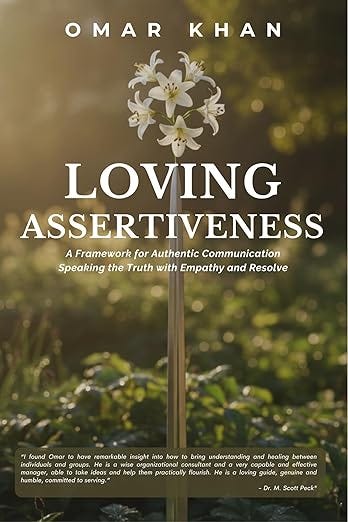
Loving Assertiveness: A Framework for Authentic Communication: Speaking the Truth with Empathy and Resolve, paperback and ebook link:
https://tinyurl.com/lovingassertiveness-pb
https://tinyurl.com/lovingassertiveness-eb
Omar’s new book, available on Amazon in March

We are the stories we tell. The world’s trove has become impoverished—thin gruel made of expediency and zero-sum thinking—while the world has never needed its citizens’ leadership more. Through marriages and boardrooms, post-conflict zones and national odysseys, Omar Khan reveals what thirty-five years across fifty countries has taught him: the choice of the stories we tell is the choice of the lives we will lead and the future we will invite.
→This piece expands on themes I explored in my recent Founders Story podcast interview about Loving Assertiveness. Listen to the full conversation Youtube:
#Kerry Patterson # Joseph Grenny # Ron McMillan # Al Switzler # Susan Scott #Communication #Organizational Development #Workplace Culture #Employee Engagement #Leadership