Human Practice
When best practice isn't enough


Bad communication makes you feel generic—no matter how eloquent, no matter how glorious it is. If you emerge from a conversation feeling like a piston rod, something replaceable, interchangeable, then it didn’t address your humanity or the specificity of your humanity.
A few weeks ago, I was helping a very dear friend negotiate with a housing contractor. The contractor had sent a solid proposal—comprehensive scope, fair pricing, clearly someone who knew their craft. But when it came to payment structure, we hit a snag.
My friend wanted to pay 25% upfront, 50% at milestone completion, and 25% at final inspection. The contractor countered with 50% upfront, 25% at milestone, 25% at completion.
His reasoning? “I always require 50% upfront. Material costs are high, and I need to secure suppliers. This is standard in the industry.”
Here’s where it got interesting.
I could have cited construction industry best practices. I could have explained why milestone-based payments protect homeowners. I could have made a logical case for why the bulk payment should come after seeing quality work completed.
Instead, I suggested my friend say something that surprised all of us:
“We’re not looking for ‘best practice’ here. We’re looking for ‘human practice’—what works for these two people in this particular situation.”
The phrase just appeared. I’d never said it before. But the moment it emerged, I knew I’d stumbled onto something important.
The fraud of “best practice”
We’ve been taught about “best practice” all our working lives. But in most cases, it’s a fraud.
Sometimes “best practice” is just shorthand for “what we’ve always done”—status quo masquerading as excellence, lack of imagination dressed up as rigor, default settings nobody’s questioned in years. It’s not actually best--it’s just common, repetitive, rote.
Then there’s actual best practice: rigorous comparison of approaches, demonstrated performance, institutionalized by the best of the best. That’s legitimate—a benchmark, a light to navigate by.
But even legitimate best practice comes up short when human dynamics enter the room.
Best practice operates in the abstract—objective, standardized, defensible. It asks: “What do the rules say? What does the data show? What has worked before?”
These aren’t bad questions. They’re just incomplete.
When I feel as special as I am, and you feel as special as you are, we know there’s been bridge-building across needs and genuine human connection.
When best practice isn’t enough
Here’s what happened with the contractor.
After my friend introduced “human practice,” the contractor escalated: “Look, I’ve been doing this for twenty years. Every single client pays 50% upfront. That’s just how construction works.”
New pressure tactic: social proof, industry standards. This is how things are done.
My friend could have defended the position. Instead, she said:
“I understand that’s your standard practice, and I respect your twenty years of experience, but here’s my reality: This is my first major home project, and I’m nervous. I need to see that we’re aligned on quality before I’m financially overcommitted. I’m not questioning your competence—I’m managing my own anxiety. Can we find something that works for both of us?”
The contractor paused, then said: “I appreciate your honesty. Most people just push back without explaining why. Tell you what—I’ll do 35% upfront, 40% at framing inspection when you can see the quality of work, and 25% at completion. That gets me enough to secure materials and gives you a checkpoint before the big payment.”
They shook hands. The project moved forward, and six months later, when a plumbing issue emerged that wasn’t in the original scope, the contractor ate half the cost because, “You trusted me, I’m going to trust you.”
The relationship deepened because both people felt special, not generic.
The litmus test: special vs. generic
Bad communication makes you feel generic—no matter how eloquent, no matter how glorious it is.
If you emerge from a conversation feeling like a piston rod, something replaceable, interchangeable, then it didn’t address your humanity or the specificity of your humanity.
Real communication makes you feel as special as you are.
When I feel as special as I am, and you feel as special as you are, we know there’s been bridge-building across needs and genuine human connection.
This is the test of whether communication is actually working—not whether the words are technically correct, not whether the process was followed, but whether both people feel seen in essence as their human needs are shone through the prism of this particular interaction or reality.
Here’s the nuance: When this happens, everyone feels special without misguidedly feeling superior--failing this, we experience ourselves as “generic.”
This isn’t about ego inflation or hierarchical ranking. It’s about mutual recognition without competitive comparison.
You’re irreplaceable, not better than. You’re seen in your specificity, not elevated above others.
This is why corporate communication so often fails even when it’s technically correct. It’s optimized for efficiency, not humanity. It treats people as resources, not as irreplaceable beings. It speaks to roles, not souls.
What human practice looks like
Let me give you three examples from organizational life.
Scenario 1: conflict in a leadership meeting
Sarah and Tom are arguing about resource allocation. The team lead suspects Sarah’s frustration stems from being overruled last quarter without explanation. Tom’s defensiveness comes from feeling his judgment is questioned given all the pressure ladled on him to deliver against a deadline. The actual resource question is solvable if the relational tension gets addressed first.
Fake best practice:
“Let’s take this offline”: translation: avoid the conflict publicly, hope it resolves itself, maintain the illusion of harmony. This isn’t best practice—it’s conflict avoidance dressed up as professionalism.
Legitimate best practice:
Use a structured conflict resolution framework; separate people from problem; focus on interests, not positions. The Harvard Negotiation Project has decades of research behind this. It works.
Human practice:
From the Team Lead:
“Hold on, before we solve the resource question, I would love to explore the human dynamics being sparked here. Sarah, you’re frustrated—are you feeling uncertain after last quarter when you were disappointed to learn we moved forward without sharing our thoughts and feelings and inviting your reactions as an input into the decision taken?
I’m disappointed we did that, too. I hope we’re learning from that.
Tom, are you hearing Sarah’s pushback as a challenge to your judgment and are concerned because of the pressure you feel to get this done somehow? Do you fear you don’t have time for such debate? And while we have the deadline, we don’t want to go in blind.
Perhaps we together have to find a real solution to this?”
This honors the proven methodology (separate people from problem) AND adapts it to these specific humans in this specific moment with this specific history.
Never be afraid of the conversations you’re having. Be afraid of the conversations you’re not having. —Susan Scott
Scenario 2: performance issue with a team member
James has been missing deadlines for six weeks. You could start the PIP process immediately--instead, you say:
“James, we need to talk about what’s happening with deadlines. I’m not coming at this punitively—I’m genuinely trying to understand. Six weeks ago, you were our most reliable person. Now you’re consistently late. What changed?”
James reveals his mother is in hospice. He’s been driving three hours each way on weekends, coming back exhausted.
Fake best practice:
“Document everything.” Build a paper trail. Follow HR protocols precisely. Protect yourself legally. This isn’t actually about improving performance—it’s CYA theater.
Legitimate best practice:
Use a performance improvement plan framework with clear metrics, specific timeline, regular check-ins. This is rigorous, fair, defensible.
Human Practice:
“I’m so sorry. Thank you for telling me. That must be so devastating, and I am so shocked we’ve created a culture where, for whatever reason, you felt you couldn’t share that.
Here’s what I can do: let’s temporarily shift your project load to things with more flexible timelines. You take the next two Fridays off without touching PTO—just go be with your mom.
Could it be “our” problem to honor your mother and our own organizational needs and find solutions that do both and support each other accordingly?
And James, could you honor us by telling us immediately if you can’t make a deadline, if something unexpected happens you have to respond to, and trust us to back you up--in real-time, though, please, not the day it’s due, deal?”
This honors organizational accountability (performance standards matter) AND recognizes that humans sometimes need the rules bent without breaking them.
Generic communication ignores both layers. Best practice often addresses human priorities but misses personal ones. Human practice honors both.
Scenario 3: client feedback on deliverables
Client comes back harsh: “This isn’t what we asked for.” You could defend the work (you followed the brief exactly). You could capitulate (we’ll redo everything).
Fake best practice:
“The client is always right.” Or its corporate cousin: “We need to manage expectations better”: translation: either capitulate to every demand or spin the narrative--neither serves the relationship.
Legitimate best practice:
Use a structured feedback loop. Clarify objectives upfront. Set clear milestones, document scope. When feedback arrives, assess against original brief professionally.
Human Practice:
“I hear you’re disappointed, and that matters to me. Let me make sure I understand what’s missing. [Listen deeply.] Okay, here’s what I’m seeing: The deliverable matches what we agreed to on paper, but it doesn’t match what you were envisioning in your head—and we didn’t surface that gap early enough.
I’m sad we haven’t incorporated ‘ongoing dialogue’ and ‘calibration’ as part of our otherwise robust delivery process. Thank you for teaching us that.
But we can respond, that’s our gift, and I’d like to demonstrate it to give you the value you are seeking.
Here’s what I propose: let’s spend 30 minutes right now getting crystal clear on what success actually looks like for you, then I’ll tell you honestly whether that’s a refinement of what we’ve done or a different direction entirely.
You have a need to be understood beyond what is on the paper. We have a need to use what’s written as a guide, and you, the living you, as the compass.
This will take partnership. I would be grateful if we could embark on that, then we all win.”
This honors professional accountability (structured scope management) AND acknowledges the human reality that what people envision often exceeds what they articulate.
The pattern
Fake best practice = following conventions without thinking, mistaking ‘common’ for ‘excellent’
Legitimate best practice = proven methodology, rigorously tested, genuinely effective when applied properly
Human Practice = legitimate best practice + contextual wisdom + relational intelligence + courage to adapt

These five movements aren’t a formula to memorize. They’re a natural rhythm that emerges when you’re genuinely present to both the human dynamics and the practical needs of the moment.
Human and personal priorities
Here’s what makes Human Practice actually work: it attends to two layers simultaneously.
Human priorities = universal needs we share by virtue of being human
To be seen and heard
To matter and have agency
To belong without losing ourselves
To be treated with dignity
Personal priorities = specific to this individual in this context with these goals:
Sarah needs to prove herself after being passed over
Tom is protecting his reputation because retirement is two years away
James is caring for his dying mother
The client envisioned something they couldn’t articulate
Generic communication ignores both layers. Best practice often addresses human priorities but misses personal ones. Human practice honors both.
When the contractor said “this is how construction works,” he was expressing both:
Human: need for financial security and professional respect (universal)
Personal: twenty years of experience, supplier relationships to protect, risk management in his business (particular)
My friend could have responded to the abstract negotiation. Instead, she spoke to both layers:
“I respect your twenty years of experience” (acknowledging his human priority for recognition).
“This is my first major project, and I’m nervous” (sharing her personal priority).
“Can we find something that works for both of us?” (inviting human practice).
He moved because he felt seen on both levels.
Why this matters now
Organizations are designed to make people generic:
Org charts reduce humans to boxes and to compound it, the boxes rarely describe what they actually do or what actually happens there.
Job descriptions make roles interchangeable
KPIs measure what’s countable, not what matters
“Professionalism” means suppressing specificity
“Scalability” means removing human variance
This is why corporate communication so often fails even when it’s technically correct.
It’s optimized for efficiency, not humanity. It treats people as resources, not as irreplaceable beings. It speaks to roles, not souls.
The result? Compliance without commitment. Agreement without alignment. Transactions without transformation.
What to do about it
After any important conversation, ask yourself:
“Did I make them feel as special as they are?”
“Did they make me feel as special as I am?”
If yes to both → Real communication happened
If no to either → Something was missing, even if the “outcome” was achieved
This is the difference between:
Agreement and alignment
Compliance and commitment
Transaction and transformation
Generic and special
You’ll start noticing:
The meeting invite that treats you like a calendar slot
The email that could have been sent to anyone
The compliment that’s too broad to mean anything
The “thank you” that’s automatic, not authentic
And you’ll start creating:
Conversations that honor who this specific person is
Feedback that speaks to their unique contribution
Acknowledgment that couldn’t apply to anyone else
Solutions authored for this relationship, not borrowed from a template
How to practice Human Practice
The litmus test (”did they feel special?”) tells you whether it worked. But how do you actually do it in the moment?
Here’s the natural rhythm that emerged across all three scenarios:
1. Meet the emotion first
Before you problem-solve, acknowledge what’s alive in the room.
“I would love to explore the human dynamics being sparked here” or “That must be so devastating” or “I hear you’re disappointed, and that matters to me.”
Don’t rush past this. One or two sentences is enough, but they’re essential. Best practice wants to get to solutions quickly. Human practice knows that unacknowledged emotion becomes the obstacle to any solution.
2. Take system responsibility
Name what failed in the process or culture, not who failed.
“I’m sad we haven’t incorporated ongoing dialogue as part of our delivery process” not “You didn’t tell us what you really wanted.”
“I am so shocked we’ve created a culture where for whatever reason you felt you couldn’t share that” not “You should have said something sooner.”
This prevents defensive spirals and makes it safe for honest conversation. You’re not assigning individual blame—you’re acknowledging a gap in how things work.
3. Reframe the difficulty
What looks like a problem is often an opportunity to learn or grow together.
“Thank you for teaching us that” transforms a complaint into a gift.
“Perhaps we together have to find a real solution” reframes conflict as collaborative challenge.
“Could it be ‘our’ problem to honor your mother and our own organizational needs” turns individual struggle into shared responsibility.
The difficulty doesn’t disappear, but it becomes something you’re facing together rather than something dividing you.
4. Name both sets of needs
Don’t pretend only one person’s priorities matter. Surface both—not as competing demands, but as legitimate realities to be honored simultaneously.
“While we have the deadline, we don’t want to go in blind.”
“You have a need to be understood beyond what is on the paper. We have a need to use what’s written as a guide, and you, the living you, as the compass.”
“Honor your mother and our own organizational needs and find solutions that do both and support each other accordingly.”
This is where “special without superior” comes alive. Everyone’s needs get named. No one’s needs dominate. The conversation becomes about integration, not victory.
5. Invite pratnership with clear boundary
End with an invitation to co-create the solution, not a demand or a one-sided offer. Include boundaries where necessary, but state them warmly.
“Perhaps we together have to find a real solution to this?”
“This will take partnership. I would be grateful if we could embark on that, then we all win.”
“Could you honor us by telling us immediately if you can’t make a deadline... and trust us to back you up, in real-time, though, please, not the day it’s due?”
The boundary isn’t harsh—it’s clear. The invitation isn’t weak—it’s generous. Both can be true at once.
Human Practice isn’t a technique to master. It’s a way of being present to what’s actually needed in each moment—honoring both the rigor of proven methodology and the wisdom of relational intelligence.
The self-check
After any important conversation, ask yourself:
Did I meet their emotion or rush past it?
If you jumped straight to solutions, you probably created emotional debt that will come due later.
Did I take system responsibility or assign individual blame?
If someone left feeling blamed, they’re less likely to be honest with you next time. The “system,” by the way, is us; it is the entire latticework of our interactions, the recurring and the situationally improvised.
Did I reframe as opportunity or stay stuck in problem?
If the conversation ended in mutual frustration rather than collaborative energy, you missed the reframe. The reframe is visible when both needs are honored, not when we keep jockeying for strategies.
Did I name both our needs or just one?
If only one person’s priorities got airtime, someone feels generic rather than special. And the “agreement” isn’t one, it’s a veneer, and can “implode” at any time.
Did I invite partnership or impose a solution?
If they’re complying rather than committing, you solved the symptom but not the system. Voluntary discretionary commitment flowing from needs and connection is the Holy Grail.
These five movements aren’t a formula to memorize. They’re a natural rhythm that emerges when you’re genuinely present to both the human dynamics and the practical needs of the moment.
You can’t fake your way through them—the other person will sense whether you’re performing empathy or actually feeling it, whether you’re inviting partnership or managing them toward your predetermined outcome.
But when you genuinely move through this rhythm, something shifts. The conversation stops being about who wins and starts being about what serves everyone. Problems become opportunities. Individuals become partners. Generic interactions become moments where both people feel as special as they are.
That’s Human Practice--that’s what happens when you honor both the rigor of proven methodology along with the wisdom and compassionate insight of present-moment discernment.
Love is the only emotion which expands intelligence. —Peter Senge
The invitation
Human Practice isn’t a technique to master. It’s a way of being present to what’s actually needed in each moment—honoring both the rigor of proven methodology and the wisdom of relational intelligence.
It asks: What’s best for these human beings, with their dynamics, in this situation, given these needs?
It creates signature solutions, not template responses.
It makes people feel special without superior, seen without generic.
And it turns out, when you communicate this way, people move—not because you won the argument, but because they experienced something rare: being treated as exactly who they are.
My friend’s contractor met her halfway. But more importantly, their relationship deepened. The project moved forward with mutual trust. And when unexpected challenges arose, they handled them as partners, not adversaries. And from this will flow many shared stories to tell, to live into, to share and to celebrate.
That’s what happens when you shift from best practice to human practice.
That’s what happens when you help people experience their genuine specialness…that is the human being we have to connect with, engage, enroll, collaborate with and grow with.
About the author:
Omar Khan is Founder & Principal of 3S Catalyst Consulting and author of Loving Assertiveness: A Framework for Authentic Communication. He has spent 35+ years working with organizations and communities across six continents, including post-conflict reconciliation work and organizational transformation. Recognized by Consulting Magazine as one of the top 25 consultants worldwide, he was mentored by Dr. M. Scott Peck and is an Oxford University alumnus. Find him at www.lovingassertiveness.com
Ready to dive deeper?
3 S Catalyst Consulting: https://3-s-consulting.com/
Loving Assertiveness workshops teach the frameworks that make this depth and breadth possible—how to move from strategies to needs, from shallow to deep, from jockeying to genuine connection.
The dates of the upcoming Loving Assertiveness workshop are: March 17th, 19th, 24th & 26th, 2026, 10:30 a.m.-12:30 U.S. Eastern Standard Time (link below).
https://drive.google.com/file/d/1ce_8PgRB4zcmOOJfMA935e_Rtc9cmqg9/view?usp=sharing
Or start with the book: Loving Assertiveness: A Framework for Authentic Communication is how we bring ourselves back, to ourselves and each other, to connection, to community, to true collaboration, and forward to the triple win: I win/you win/the world wins.
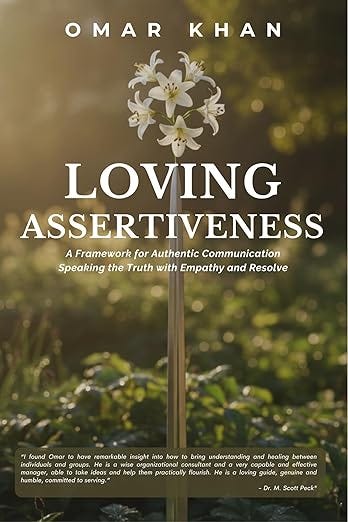
Loving Assertiveness: A Framework for Authentic Communication: Speaking the Truth with Empathy and Resolve, paperback and ebook link:
This piece expands on themes I explored in my recent Founders Story podcast interview about Loving Assertiveness. Listen to the full conversation Youtube:
->The articles about Omar Khan’s book, Loving Assertiveness:
https://omarskhan.substack.com/p/the-tea-that-changed-everything?r=57pzq

And
https://omarskhan.substack.com/p/human-practice?r=57pzq

#Human Practice #Leadership #Business #Management #Relationships #Productivity